“Are you still waiting, honey?” the waitress asked, coffee pot in hand as she approached the booth. I wondered how the answer wasn’t obvious since I was still sitting alone. I tapped my cigarette with my forefinger just over the rim of the ashtray as I nudged my mug toward her.
“Yes, ma’am,” I answered as she filled the cup, a motion so smooth and exact it could almost be called graceful. “Thanks.”
Her smile held an admirable amount of teeth for a Waffle House waitress. “No problem, sugar.” Squinting to prevent smoke from getting in my eyes, I exhaled audibly and reached for the sugar dispenser. Sweetener poured as I counted to three in my head, the last number stretched long enough to warrant a few more E’s were it spelled phonetically. I stubbed out my cigarette with my right hand while stirring coffee with a spoon in my left, the jaded, young adult equivalent of patting your head while rubbing your stomach.
I had agreed to meet my father with some consternation; this place was, undoubtedly, an important fixture in the Rayburn family history. On Dad’s court-mandated weekends and summer vacation visits, Waffle House was where we went for breakfast – mainly because it served breakfast all day long. If he stayed in bed nursing a hangover until mid-afternoon, an occurrence which became more frequent as my sister and I grew older, Dad could then maintain a semblance of parental effort, having fed us the day’s most important meal.
Once over a Labor Day weekend, having grown aware of the routine and hoping for variety, I complained about the prospect of eating there for the fourth day in a row. Dad looked at me and my sister in bewilderment. “The menu says right there on the front that they have over one million combinations of hash browns. You just haven’t found your favorite yet.” Dad’s reasoning and Waffle House math both seemed flawed to me. Ashley, my little sister, five at the time, gaped in amazement, awed by the unfathomable number of ways that potatoes, grease, and other commodities could be combined and sold as breakfast. Regardless, I still enjoyed the place as an adult. There seemed to be a Waffle House on every corner, and, though not identical to one another, they were all familiar enough to provide a feeling of comfort. Endless coffee and an indoor smoking section were amenities I appreciated on hot Texas days.
So when the phone rang with a call from the treatment center Dad had been in for the last six months, I decided, even before picking up the receiver and saying hello, that we would meet in person for the first time in nearly five years over scattered hash browns and pecan waffles.
Dad and I wrote back and forth during his time in rehab, a line of communication I had decided was worth opening. We hadn’t spoken over the phone for at least a year before he entered treatment, but I felt letter writing could be beneficial both to his recovery and to mending our relationship. I kept all the letters he wrote and marveled at how his handwriting had become less shaky as time went on. His spelling, however, remained atrocious. I had hoped that with sobriety would come latent grammar skills but was ultimately disappointed. He mailed two letters in the month of Febuary despite my response to the first one with the word spelled out in all capital letters, the R traced over twice and darkened. I read each of his letters with a strange mixture of emotions; partly I was elated that he was finally getting treatment, taking actual steps to better his life. On the other hand, I wondered what the implications of Dad’s sobriety were. It was like finding a cure for Alzheimer’s only to be burdened with the task of delivering the news to grandpa that his cat got run over six years ago and we were again at war in the Middle East. There was a huge portion of my life, long before the three years Dad and I were incommunicado, that I’m sure hadn’t stuck to the whisky-sodden walls of his brain. I infused the letters I wrote to him with subtle reminders of important aspects of my teen years, those in which his drinking spells were most protracted, in an effort to trigger memories or, at least, interest.
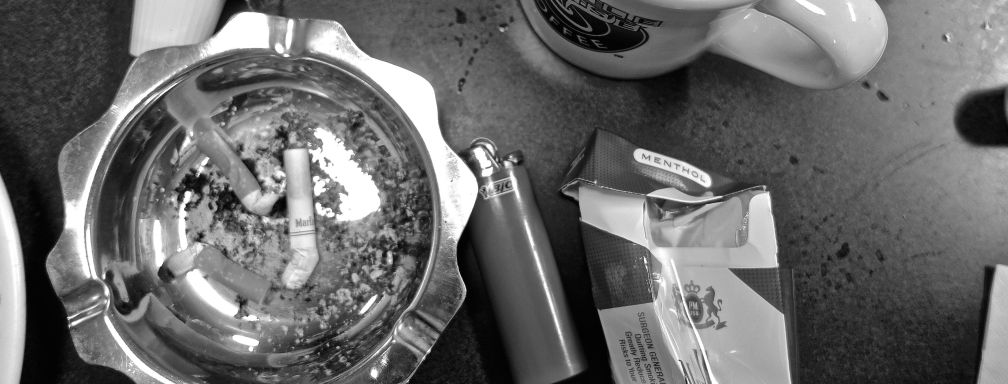
As lunch time approached, the other booths in the restaurant started to fill, increasing the mixed clamor of conversation, clanking dishes, and cryptic food orders yelled to the line cooks. Cigarette smoke billowed to the yellowed ceiling tiles from almost every table as I leaned back, resting my head against a window. The situation’s absurdity briefly crossed my mind: a reunion between an alcoholic father fresh out of rehab and his estranged gay son on the cusp of college graduation, taking place at a restaurant whose jukebox contains songs about grits and raisin-toast. I inhaled slowly and deeply the aromas of cheese and grease, of smoke and coffee. The setting felt normal; that was the absurd part. But my relationship with Dad seemed fraught with moments of absurdity, strung together by holiday get-togethers and birthday bowling parties. Sometimes they overlapped, like at Thanksgiving dinner, 1997, at Aunt JoLynn’s.
Ash and I had been living with JoLynn since early summer following Dad’s latest DUI arrest. For weeks leading up to the holiday, my aunt had pressed for Dad’s commitment to attend Thanksgiving dinner, and the hours prior to the party were filled with nervousness and uncertainty regarding his coming. By mid-afternoon the family had grown impatient waiting for Dad to arrive, and JoLynn, perturbed with her brother’s reputation as a drunkard, decided to declare it dinnertime without him.
As everyone else gorged, I picked at my plate with little interest. I had made up my mind that morning that I was going to come out of the closet to my entire family during the dessert course, having thought it best to allow tryptophan to take effect before ripping off the rainbow Band-Aid.
Right as Uncle Eddie lifted his first bite of apple pie to his lips, everyone heard a crashing noise on the front porch. JoLynn and I were up first, and we rushed to the door at the same time. I reached for the knob, but she slapped my hand away and peered through the peephole.
“I don’t see a goddamn thing,” she whispered.
“Fuck me running,” I heard from the other side of the door in my father’s recognizable rasp. I grabbed for the handle again and yanked. There was a crunching noise as the cartilage of my aunt’s nose snapped, followed by a wail that resembled a Shih Tzu’s bark. She stumbled backward, grabbing at her face, as I opened the door wide. Dad had tripped walking up the stairs to the porch and fallen into the glass-topped tea-table that had sat for years in front of the bay window. He lay in an awkward pose with one leg bent at ninety degrees, the world’s unsexiest Playgirl model. He was dazed, surrounded by broken glass with a nearly empty bottle of Wild Turkey in his right hand. He belched loudly, lifted the bottle into his wavering line of vision, and apologized to it.
“For fuck’s sake, Roger,” Uncle Joe said as he stepped out and surveyed the scene, pie-filling clinging to his mustache. The rest of the family made their way to the porch, faces filled with horror. I stepped between my drunken father and our family, turned to the huddle and declared in an octave higher than rehearsed, “I’m gay.” There was silence for the next few seconds except for the drip of blood from JoLynn’s nose falling onto the wooden porch.
My head was still against the Waffle House window when Dad opened the door. The large pane flexed slightly with the change in air pressure. As I turned in the booth, my left hand knocked the sugar dispenser off the table; it smashed on the floor with a thick crack, like a gun discharged under water. An older couple in a nearby booth looked at me with matching expressions of contempt. The woman was so started that her bite of chocolate pie fell from her fork with a splat, a puny retort to the sugar dispenser’s thwack.
“Fuck me running,” I mumbled aloud as I looked at the mess of white sugar against brown-and-tan tile.
Approaching quickly, Dad used the sole of his shoe like a broom to scrape the chunks of glass into a pile. I noted the balance that the act required and smiled.
“Well, I was worried about breaking the ice, but, damn, son, you broke the sugar.” He laughed at his own joke, behavior that used to bother me.
My smile broadened, and I stood to give him a hug. “Hey, Dad.”
Sugar granules crunched beneath our feet as we embraced. I hugged him tightly, and a small lump formed in the back of my throat. Determined not to cry, I inhaled a deep, controlled breath through my nose. Dad’s traditional scent of Old Spice and alcohol was no longer there, replaced instead by something musty and oddly familiar. I pulled back and looked him over. He was thinner than I had last seen him, looking healthier that I could remember. His hair was short, he sported a well-grown beard that I had seen on him only in old photographs, and he was wearing different glasses. His eyes were bloodshot.
“Are you stoned?”
He slid into the booth. I remained standing, staring down at him. I was positive the look on my face matched the tone in my voice — one of pure incredulousness. “Maybe just a little,” he smirked. “Sit down, Bub.” The waitress approached with a broom, a dustpan, and an annoyed countenance.
“I’m so sorry, ma’am. I didn’t mean to kno-.”
“You’re okay, sugar, but the sugar sure ain’t.”
Dad snorted, and I stood in the debris, arms akimbo and lips pursed.
After a few seconds of my astonishment going unnoticed, I sat down across from him, arms crossed and red-faced, as the waitress took his order. My appetite, extinguished by nicotine, caffeine, and indignation, was nil. I nodded when asked if I wanted more coffee and continued to stare in any direction other than directly in front of me. An obese woman in paint-stained overalls with her hair in a Scruncci walked to the juke-box with a dollar in hand; two Mexican children used straws to blow bubbles into their glasses of milk as their parents argued in Spanish; an elderly couple exchanged sections of that day’s newspaper, passing them over grease-streaked plates and empty cups. Dad and I exchanged silences as we waited for the waitress to bring a fresh pot and another mug. When she approached the table, hands full, a new sugar dispenser was in the crook of her arm.
“Thank you, ma’am,” Dad said.
“Your order will be up in a minute, honey. You sure you’re not hungry?”
I shook my head and reached for my cigarettes on the window sill. I lit one, blew the smoke from my nostrils like an angry cartoon character, and reached for the sugar. Dad reached for it at the same time, forcing me to breach my policy of utter dismissal. We looked at each other for maybe two seconds; his brow was furrowed and he grinned a Mona Lisa half-smile, a look I myself had worn many times — one that I thought made me look playfully condescending yet approachable. On him though, it looked like pity.
Simultaneously, we started to speak then both immediately stopped, our attempts at conversation overlapping. We stared at one another in a polite standoff. In the silence that followed, the obese lady’s first juke-box choice began playing over the ceiling’s embedded speakers; “Achy Breaky Heart” filled the restaurant. Back at her table, she sang loudly between bites of heavily buttered Texas Toast.
It was absurdly appropriate. My lukewarm convictions crumbled under the weight of irony and humor. “You go first,” I said and pushed the sugar dispenser toward him, his half-smile filling out to a full one.
“Thanks, Bub.” He took the dispenser, turned it upside-down, and began to pour. In what was little more than a whisper, I heard him counting aloud. ”One, twooooo, threeeeeeeeeeee.”
 Skyler D. Williams