Again, as if with sobriety came the ability to know what I was thinking, Dad said, “I didn’t mail it ‘cause I thought you might actually agree to the whole not gonna impose on your life, never contact you again part.”
I set the letter on the table and leaned back in the booth, the orange padded cushion pressing coolly through my shirt. The restaurant’s atmosphere had sharpened. Silverware from every booth clinked against plates and mugs like metallic raindrops on ceramic grass, and the browns and yellows of the long-outdated decor seemed saturated with light. In this new place, this same old Waffle House, Dad looked both remorseful and hopeful, simultaneously young and old, like a house that was built but never occupied.
“You’re probably right,” I said, crossing my arms over my chest. On the table the letter sat bent at odd angles, and it caught my breath again as I exhaled. It slid toward Dad’s plate, stopping short as it reached my spoon, which rested in a small puddle of coffee. The paper absorbed the liquid, and a stain blossomed near the bottom of the page as if it had been stamped and verified by our gap-toothed notary.
“But then I got that letter you wrote on Thanksgiving, and I decided to hold on to it until we could do — this,” he finished with a flit of his hands, indicating both of us and the restaurant.
“Ash and JoLynn never said a word to me about getting one of these from you,” I said, miffed.
“That’s ‘cause I only wrote one, Bub.”
I looked up at him and blinked.
Taking my stunned silence as an apparent need for clarification, he nodded toward the letter. “To you.” He reached across the table, unfolded and flattened the paper with his left hand, and placed the sugar dispenser squarely in its middle with his right. He leaned forward on his elbows, arms parallel to his chest, hands flat on the table — body language that may as well have screamed, I’m ready to talk.
Still leaning back, arms crossed, my mannerisms were in direct but silent opposition to his.
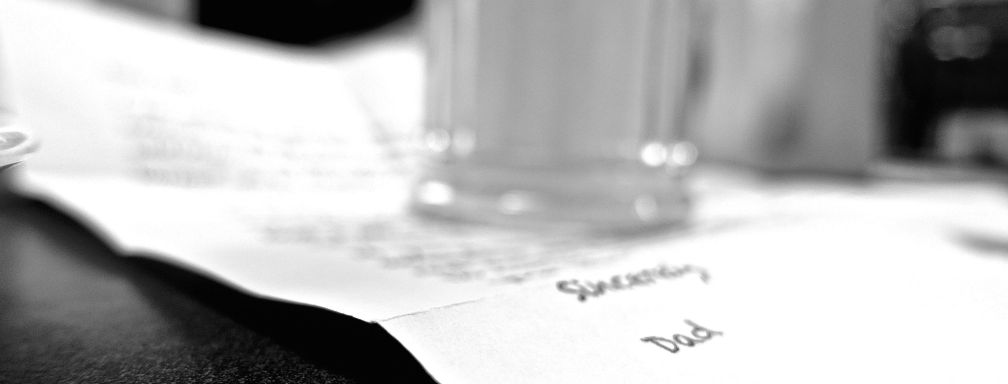
“Now, I wrote only to you ‘cause I figured I’d done you the most harm, Bub. I’ve hurt everyone in many ways, all of which I’m real sorry, but I ignored a very important part of your life.” He reached over and tapped on the postscript. Fallen crumbs from the stolen triangle of toast crunched between the letter and the table, forming a small grease spot, like a bullet mark of emphasis before the words don’t give a shit. “I’m sure I wrote that real bad,” he continued, “but that was just my third day sober, and withdrawals are a motherfucker.”
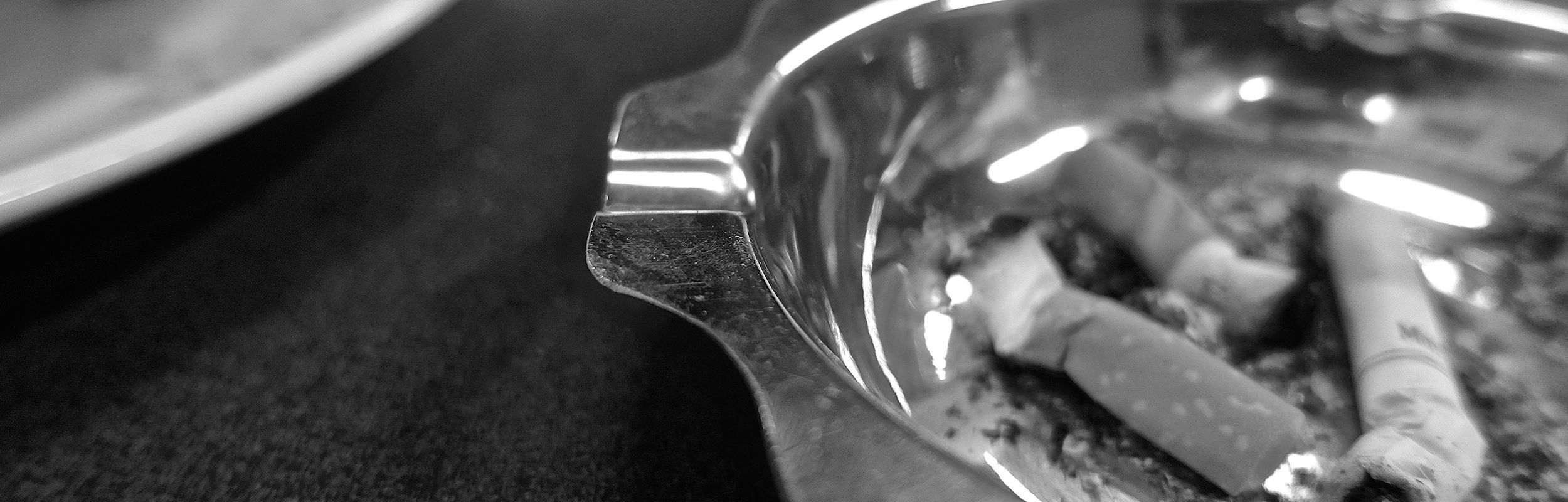
I took the last cigarette from the flip-top box, stuck it between my lips, and crumpled the empty pack with both hands. A ringing arose in my ears as I laid the crushed pack atop the napkin holder. Before I could reach for my lighter, Dad snatched it from the window sill and tucked it beneath his other palm. Lowering my head, I stared at his unfinished steak. The cheap cut of meat looked dry and pale.
“Bub, look at me.”
I sat there, addled and downcast, with an unlit cigarette dangling from my mouth as my father held my Bic for emotional ransom. Though a couple of my letters to him had alluded to my coming out, I hadn’t prepared for my sexuality to be a talking point during our Waffle House reunion. Recalling that Dad had written his apology letter first, and in it, mentioned my sexuality directly instead of throwing it in as an aside as I had, I briefly steeled myself for the conversation I never thought we would have. I looked up, my face flushed.
Tapping his index fingers on the table, Dad cleared his throat and asked, “So, what kind of guys are you into, Bub? Do you have a boyfriend?”
The cigarette tumbled from my slackened mouth. I clumsily tried to catch it but instead knocked it to the floor where it rolled under the black, non-slip soles of our approaching waitress. I leaned to look beyond her as she set down my plate of hash browns. My shoulders slumped; the cigarette had snapped in two at the filter.
“God damn it,” I moaned, leaning back in the booth.
“You’re supposed to bless your food, sugar, not cuss it,” she said in a playful tone that suggested familiarity, as if she were now serving old friends. This time, however, her smile was not returned by either of us. Craning her neck, she followed Dad’s gaze to the flattened cigarette, its disgorged tobacco blending in with the brown tile and grime. “Oh, shit,” she said turning back to the table. She then reached into her apron pocket, pulled out a battered soft-pack of menthols, and tapped the bottom until a speckled filter protruded. Holding it out to me, she said, “They say these things crystallize your lungs. Fine by me. Give the doctors something pretty to look at when they cut me open.” Her voice had dropped the pretenses of customer service, and she spoke with an understanding shared solely among smokers.
“Thanks,” I said, forcing a smile. She walked away, and I turned back to face Dad, who was still concealing my lighter.
“Bub, I’m serious. You deserve my support and acceptance, and you have both. I’m sorry it took me five years and a trip to rehab to tell you.”
“Can I have my lighter, please?” I asked flatly.
Dad’s fingers curled into loose fists, his face tightened, and his back straightened. With pink and glassy eyes, he resembled everyone in the family who had tried to talk to him over the past fifteen years. Though our red eyes had been the result of crying, not smoking, his posture of impatience and disappointment was a copy of those displayed to him at every therapy session and family event. It struck me how much he looked like his sister, those same tired eyes and forlorn expression that had worn themselves into her face with permanence.
Across from me, over steaming hash browns, Dad frowned at my unwillingness to talk just as we had done at his inability to listen. With the mere mention of my sexuality, our roles had reversed; he was the one reaching out, and I was the one closing up. Where he had the valid excuse of a debilitating disease, I was just a prick.
I slowly rolled the cigarette between my thumb and forefinger, contemplating it. Prolonging our discussion by lighting it might be like lighting a fuse, a catalyst that could destroy the gossamer bindings of our freshly-rekindled relationship. One strike of a lighter could undo six months of sobriety and negate fifteen years of emotional turmoil. Conscious of the moment’s importance, I sighed and tucked the cigarette behind my right ear, leaned forward, and slid the stained letter out from under the sugar dispenser. An imprinted ring remained where the canister had rested, and bits of stray ash had peppered the right margin, further marring the paper’s appearance. Safe in its protective envelope for six months with its inscribed intentions tightly pressed and preserved, the letter now lay open and bare, looking scarred and worn, honest and real.
The stains of coffee and grease did not devalue Dad’s words — they added presence. It was presence, if nothing else, that we had both agreed upon offering one another when we had arranged this reunion.
I read the postscript once more before refolding the letter and tucking it back into the envelope. Elbow propped on the table, hand pointed upward, I held the paper between my index and middle fingers like a cigarette. Using the same key turning motion with which the letter had been offered, I looked Dad in the eyes and said, “Apology accepted.”
His hands, shoulders, and face loosened. With lips pressed together in a muted smile, he nodded slowly, and, for the first time since we had sat down in the noisy restaurant, we shared a silence devoid of awkwardness. In that wordless moment, in that exchange of smiles, I knew that Dad had both feet planted securely one step higher than he had when he arrived. He held the Bic out to me, flat in his palm.
I returned the same slow nod, took my lighter from his hand, and put it back on the sill.
“You’d better eat your hash browns before they get cold,” he said, poking at his left-over steak with his finger. “This shit’s only good for so long.”
I removed the ketchup bottle from the condiment caddy and cleared my throat. “Bald and skinny,” I said. I removed the cap, upended the bottle, and began to smack the thick glass base with the meat of my palm. Dad’s eyes narrowed, and his brow wrinkled in confusion.
I had waffled long enough. “To answer your question,” I continued, punctuating every other word with the sound of skin on glass, “I like my guys bald and skinny.”
 Skyler D. Williams